
How to Unload Groceries Without Dropping Items
You know the moment. The trunk is open, one bag is cutting into your fingers, a gallon jug is swinging into your leg, and the bag with the eggs is somehow under everything else. If you are figuring out how to unload groceries without dropping items, the problem usually starts before you ever get home.
Most grocery drops are not really about clumsiness. They happen because bags shift, thin handles twist, weight gets distributed badly, and too many items compete for one trip. Add wet hands, stairs, kids, bad weather, or a heavy weekly haul, and even a short walk from the car to the kitchen becomes annoying fast.
The good news is that this is fixable. A better unload routine does not require much time, and it definitely does not require superhuman grip strength. It comes down to organizing the load, controlling the weight, and using tools that reduce strain instead of adding more of it.
Why groceries get dropped in the first place
The usual failure point is not the bag bottom. It is the handle situation. Plastic and thin reusable handles bunch together, dig into your hands, and slide against each other. That makes the load less stable and a lot harder to control, especially when one bag is heavier than it looks.
Weight distribution is the next issue. If canned goods, bottles, produce, and cleaning supplies all end up packed randomly, the bag swings instead of staying upright. That swing pulls on your wrist and fingers, and once one bag starts slipping, the rest tend to go with it.
Then there is the one-trip mindset. It sounds efficient, but it often leads to overloaded hands and rushed movement. For some people, especially older adults or anyone with hand or wrist discomfort, trying to carry everything at once is exactly what turns a routine unload into dropped produce, smashed bread, or a sore forearm for the rest of the day.
How to unload groceries without dropping items starts at checkout
If you want the trip from car to house to go smoothly, the work starts when items are bagged. This is where a lot of avoidable mess begins.
Group groceries by both category and weight. Heavy, dense items should be packed together, but not to the point where one bag becomes a deadlift. Keep crushable items separate from cans and bottles. Cold items can stay together, but make sure they are not all concentrated in one overloaded bag while the others are half empty.
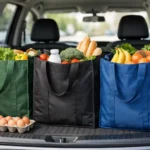
Reusable bags help, but only if they hold their shape and are packed intelligently. Floppy bags with long handles can still sag and swing. Structured bags or bag systems that stay more upright are easier to grab, easier to stack in the trunk, and less likely to spill when you lift them out.
A quick pause at checkout is worth it. If a bag already looks stretched, lopsided, or awkward to lift, it will not improve later in the parking lot.
Set up the car so unloading is easier
A lot of people toss bags into the trunk however they fit and deal with it later. That creates a pile, not a system.
Place heavier bags flat and closest to the trunk opening so you can reach them without leaning deep into the car. Put delicate bags on top or in a spot where they will not get crushed during the drive. If you have a bag carrying tool or holder, keep it within easy reach instead of buried under everything else. The first few seconds at the car matter because that is when people start grabbing too much, too quickly, at bad angles.
It also helps to think in unload order. Put refrigerated and frozen items where they come out first. Put cleaning products or non-urgent household items farther back if they can wait for a second trip. That small bit of planning reduces rushed juggling.
Use fewer pressure points on your hands
One of the simplest answers to how to unload groceries without dropping items is to stop carrying each handle with your fingers alone. Thin handles create pressure points, and pressure points lead to weaker grip.
When several bag handles are gathered onto a single ergonomic carrier, the load becomes easier to manage because the handles stop separating and tangling. Instead of five or six cutting lines across your fingers, you have one stable hold. That matters for comfort, but it also matters for control. A more secure grip means less handle slippage, less bag swing, and less chance that one bag peels away from the rest halfway to the door.
This is especially useful if you regularly carry plastic grocery bags, rope-handle retail bags, or reusable bags with narrow handles. The problem is not only weight. It is the way the weight gets transferred into your hand.
Make the first trip the smart trip
If you are unloading a full grocery run, the goal is not always one trip. The goal is the right first trip.
Take the items that are most temperature-sensitive, most fragile, or most likely to leak if tipped. That usually means frozen food, refrigerated food, eggs, bread, and produce. If those make it inside safely, the rest can follow without much risk.
For people with stairs, a long driveway, or limited grip strength, two controlled trips will almost always beat one overloaded trip. The trade-off is a little extra walking, but you lower the odds of dropping something expensive, breakable, or messy. That is usually a good exchange.
Slow down at the handoff points
Most grocery spills happen at transitions, not during the walk itself. Lifting bags out of the trunk, opening the house door, stepping over a threshold, and setting bags onto a counter are the moments when loads shift.
At the trunk, bring the bag or carrier fully into your hand before you turn away. At the door, put the load down if you need a free hand for keys or the knob. Inside, set bags onto a stable surface instead of dropping them onto the floor where they can tip or get kicked over.
This sounds obvious, but in real life people rush the handoff. They brace a door with one foot, twist sideways, and try to save time. That is where the milk swings, the produce rolls, and something ends up hitting the porch.
Match the method to your body
Not every grocery strategy works for every person. If you have arthritis, wrist pain, reduced grip strength, or numbness in your fingers, the standard advice to just carry less may not solve the real problem. You may need better handle support, more stable bags, or a way to consolidate multiple bags into one controlled hold.
For busy parents, the challenge may be managing groceries while also handling a child, a diaper bag, or a distracted dog. In that case, organization matters even more than raw strength. A compact carrying tool that lives in the car can be more useful than a larger storage solution you forget at home.
For apartment dwellers, balance and portability matter. Long hallways, elevators, and stairwells make swinging bags much more annoying. A stable, ergonomic carry setup reduces that constant stop-and-readjust cycle.
A better system beats better effort
People often treat grocery unloading like a minor chore that should not require strategy. But if it frustrates you every week, then the system is not doing its job.
A good system keeps bags organized from checkout to trunk to kitchen. It reduces the strain on your hands, prevents handle tangles, and keeps fragile items from getting buried. It also makes your movements more predictable, which is what lowers the chance of drops.
That is why product design actually matters here. A well-made bag carrier with real load capacity and compatibility with different handle types is not a gimmick. It solves the exact mechanical problem most shoppers deal with – too many narrow handles, not enough comfort, and too much opportunity for something to slip. The BAGGLER was built for that everyday problem, which is why it helps turn a messy armful into one secure, manageable carry.
Build a routine you will actually use
The best grocery routine is the one you will repeat when you are tired, in a hurry, or unloading in the rain. Keep your reusable bags and carrying tool in the car. Bag items with intention. Load the trunk in a sensible order. Take the first trip based on what needs protection, not just what is closest.
If something keeps going wrong, pay attention to the pattern. Maybe your bags are too flimsy. Maybe you are overpacking heavy items. Maybe the real issue is handle strain, not total weight. Once you identify the failure point, the fix tends to be pretty straightforward.
Grocery unloading does not need to feel like a balancing act. With a little planning and a better grip setup, you can make the trip from car to kitchen calmer, safer, and a lot less irritating. That is a small upgrade, but it pays off every single week.
 Previous Post
 Next Post